
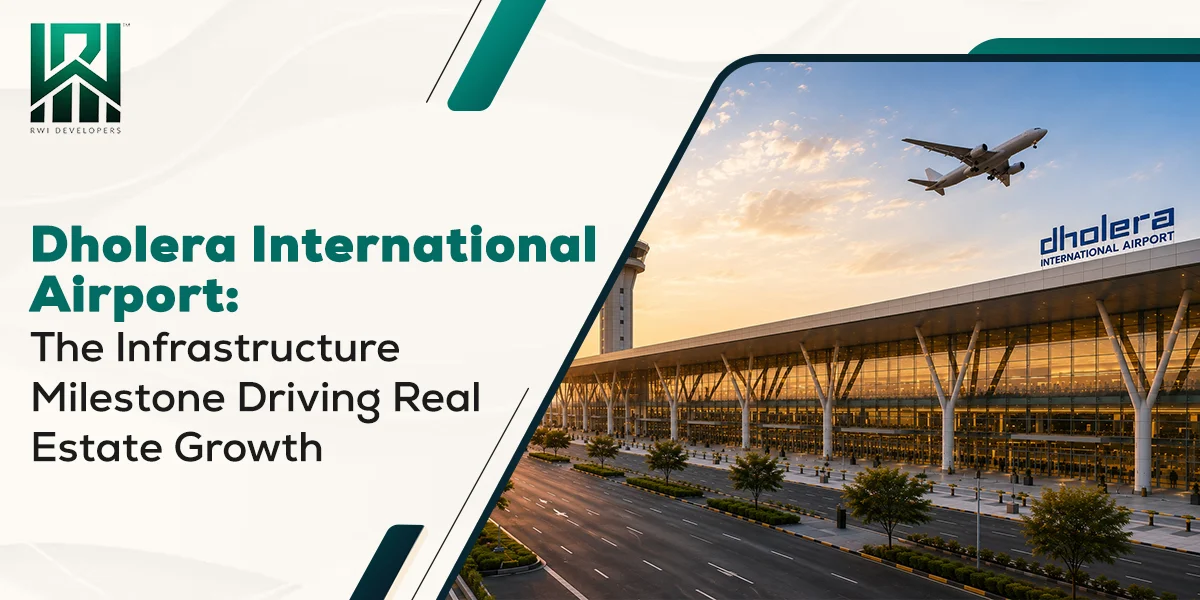
For years, Dholera Smart City has been discussed as a future possibility, a city on paper, backed by ambitious government plans and a name that kept surfacing in conversations about Gujarat’s next big growth story. In 2026, that conversation has shifted. Dholera Special Investment Region (SIR) is no longer a blueprint; it is an active construction site, an operating semiconductor zone, and now, the location of a greenfield international airport that has moved from planning into its final testing phase.
Among everything happening across Dholera Smart City Gujarat right now, the airport stands out as the single infrastructure milestone most likely to reshape how investors and homebuyers think about the region. Airports don’t just move people, they move money, industry, and long term demand. For anyone tracking Dholera as an investment destination, understanding where the airport stands today, and why it matters, is no longer optional homework. It’s the context every other decision about Dholera sits inside.
Where Construction Stands Today
The Dholera International Airport is being developed by Dholera International Airport Company Limited (DIACL), a joint venture between the Airports Authority of India (AAI), the Government of Gujarat, and the National Industrial Corridor Development and Implementation Trust (NICDIT). It sits on a 1,426-hectare site near Navagam village, roughly 15-20 km from the Dholera SIR activation area and about 80-100 km from Ahmedabad.
As of early 2026, the project has crossed its most significant structural milestone: Phase 1 civil works were completed in December 2025. The airport now has a 3,200-metre Code 4E runway — long enough to handle wide-body commercial aircraft — along with a completed terminal structure, cargo handling facility, and air traffic control tower already in place.
Calibration flights were conducted between January and February 2026, and the airport entered full operational trials from March onward. This is the licensing and testing stage that precedes commercial flights — a meaningfully different status from “under construction.” Phase 1 is designed to handle 1.2 to 1.5 million passengers annually, with future phases planned to scale capacity up to 50 million passengers a year as the surrounding region grows.
It’s worth being precise here: while government statements have pointed to airport operations beginning in 2026, the exact date for full commercial passenger flights has not been officially confirmed by AAI. Infrastructure timelines in India can shift, and readers evaluating the dholera project current status should treat 2026 as the targeted window rather than a guaranteed date. What is confirmed and verifiable is that the project has moved well past the planning stage into active testing — a distinction that matters for anyone assessing how real this milestone actually is.
Why the Airport’s Location Is No Accident
The airport’s positioning is deliberate. It sits close enough to Dholera SIR to function as the region’s dedicated logistics and passenger gateway, while also being positioned to relieve pressure on Ahmedabad’s Sardar Vallabhbhai Patel International Airport, which has been operating near capacity for years.
That dual role matters more than it might first appear. Dholera SIR is not a standalone township it’s the largest node in the Delhi-Mumbai Industrial Corridor (DMIC), a 920 sq. km greenfield industrial city being developed jointly by the Government of India and Gujarat. It has been designated India’s first semiconductor city, and that designation is no longer aspirational. Tata Electronics, in partnership with Taiwan’s PSMC, is constructing a ₹91,000 crore semiconductor fabrication plant within DSIR’s TP4 zone, with the first chip batch targeted by December 2026. The project is expected to create over 20,000 direct skilled jobs in its first phase alone, with total employment impact including indirect roles in services, retail, and hospitality estimated between 60,000 and 100,000 people over the next five to seven years.
A semiconductor fab of that scale doesn’t operate in isolation. It needs reliable air cargo access for sensitive components, business travel infrastructure for global partners and engineers, and a way to move people in and out of a region that, until recently, had none of that. The airport is the piece that makes the rest of DSIR’s industrial ambitions logistically viable not a side project, but a precondition for them.
Beyond serving as an aviation hub, the airport is increasingly being positioned as the centrepiece of a broader aerotropolis ecosystem. During a recent review of the project, Union Civil Aviation Minister Ram Mohan Naidu highlighted that the airport is expected to become a catalyst for manufacturing, logistics, aerospace, and green industries across the region. The government has also outlined plans to integrate the airport with the Ahmedabad–Dholera Expressway, a dedicated high-speed rail station adjacent to the terminal, and future multimodal logistics infrastructure. Adding further momentum, Dholera has been selected as the site for a proposed final assembly line under the Embraer–AdAviation Systems partnership, while the region is also being positioned to support maintenance, repair and overhaul (MRO) activities for India’s growing aerospace sector. Together, these developments reinforce that the airport is being planned not as a standalone transport facility, but as the economic gateway for Dholera’s next phase of industrial growth.
Connectivity is improving on the ground as well. The Ahmedabad-Dholera Expressway, an under-construction corridor of roughly 88-109 km, is designed to cut travel time between Ahmedabad and Dholera to around 60-90 minutes, with a dedicated interchange planned to give direct access to the airport itself. As that expressway nears completion, the practical distance between Ahmedabad and Dholera already shrinking on paper starts shrinking in real terms too.
Why Infrastructure Milestones Move Real Estate Markets
There’s a reason real estate analysts watch airport announcements closely, and it isn’t sentiment. Airports concentrate economic activity in a way few other types of infrastructure do. They draw logistics parks, hotels, business travelers, IT and service hubs, and over time the residential demand that follows people working in those sectors. India has seen this pattern before: in cities like Hyderabad and Pune, areas near international airports and industrial corridors saw land values climb well ahead of city-center growth rates, precisely because economic activity clustered around the infrastructure first.
Dholera is a greenfield smart city, which makes this pattern even more pronounced than it would be in an established city. There’s no existing urban core competing for attention — the airport, the expressway, and the semiconductor ecosystem are being built in parallel, which means the region’s growth story isn’t waiting on any single piece. As each milestone clears (expressway completion, airport trials, the Tata fab’s first chip), it reduces the perceived risk for the next wave of investors and businesses considering the region.
This is the broader context behind rising interest in dholera investment conversations across forums, advisory platforms, and search trends. It isn’t just enthusiasm about a smart city concept — it’s a response to verifiable progress: a tested runway, an operational semiconductor zone, and a near-complete expressway, all converging in the same 12-18 month window.
What This Means for Plot Investors in Dholera
For anyone evaluating property in dholera, the airport’s progress changes the calculus in a few concrete ways.
Commercial and industrial demand will likely lead. Logistics operators, component suppliers to the semiconductor ecosystem, hospitality businesses serving business travelers, and service providers supporting the growing DSIR workforce are the categories most directly tied to airport activity. These tend to generate demand for commercial and mixed-use plots before residential demand fully matures.
Residential demand follows employment, not announcements. With Tata’s fab targeting 20,000+ direct jobs and a much larger indirect employment base, the workforce moving into the region over the next several years will need housing. Reports indicate over 1,500 serviced apartments are already under construction to support this workforce, which signals that demand for residential land including plotted developments is being anticipated by planners, not just hoped for by marketers.
Dholera land price trends reflect this staged growth. Search and market data show steady, if still early-stage, movement in dholera land price and dholera smart city plot price figures. This is consistent with what infrastructure-led growth typically looks like in its earlier phases: gradual, tied to verifiable progress, rather than speculative spikes disconnected from ground reality.
Timing is about infrastructure milestones, not market hype. The most reliable signal for evaluating entry timing in a project like Dholera isn’t sentiment, it’s milestones. Expressway completion, airport commercial operations, and the semiconductor fab’s first production run are the markers worth watching. Each one reduces uncertainty and tends to be followed by increased developer and investor activity.
RWI’s Perspective on Dholera’s Growth
This is precisely the kind of environment where the quality of the developer matters as much as the location. As one of the established real estate developers in Dholera, RWI has built its plotted development approach around this region’s specific growth trajectory focusing on residential plots in Dholera in zones positioned to benefit from the connectivity and industrial momentum building around Dholera SIR.
For buyers evaluating Dholera residential plots, the difference lies not just in where a project is located, but in how well it aligns with the city’s long-term master plan. At RWI, every development is planned with the understanding that infrastructure, employment hubs, and connectivity will continue to shape the region’s evolution. Rather than responding to growth after it happens, our focus is on creating developments that are positioned to grow alongside Dholera itself.
The Bigger Picture
The Dholera International Airport isn’t a future promise anymore — it’s a runway that’s been tested, a terminal that’s been built, and a project that has moved from “planned” to “in trials” within the span of a few months. Combined with a semiconductor fab under active construction, an expressway nearing completion, and continued government investment, the case for Dholera Smart City Gujarat as one of the fastest-growing cities in Gujarat is no longer theoretical, it’s visible on the ground.
As Dholera enters its next phase of growth, the conversation is shifting from whether the city will develop to how it will evolve. For those looking at the region today, infrastructure is no longer just a promise, it’s becoming the foundation for long-term value.
Interested in exploring plotted developments in Dholera Smart City? Connect with RWI Developers to discover projects thoughtfully planned for the next phase of Dholera’s growth.