
Governments don’t choose locations for first-of-their-kind infrastructure projects by coincidence. They choose regions they believe will shape the country’s future.
That is precisely what makes the recently approved Ahmedabad–Dholera Semi High-Speed Rail Corridor significant.
When Railway Minister Ashwini Vaishnaw announced the Union Cabinet’s approval for India’s first indigenous semi high-speed rail corridor connecting Ahmedabad (Sarkhej) and Dholera, the announcement was about far more than introducing a faster mode of transport. It was a strong indication of the strategic importance being assigned to Dholera within India’s long-term infrastructure, industrial, and economic vision.
At RWI Developers, we believe infrastructure announcements become meaningful when viewed in context. Individual projects matter, but it is the convergence of infrastructure, industry, and planning that defines how a region evolves over time.
The Ahmedabad–Dholera Semi High-Speed Rail Corridor is one such milestone.
The bigger question, therefore, is not what the project is.
It is why Dholera was chosen.
Project Snapshot
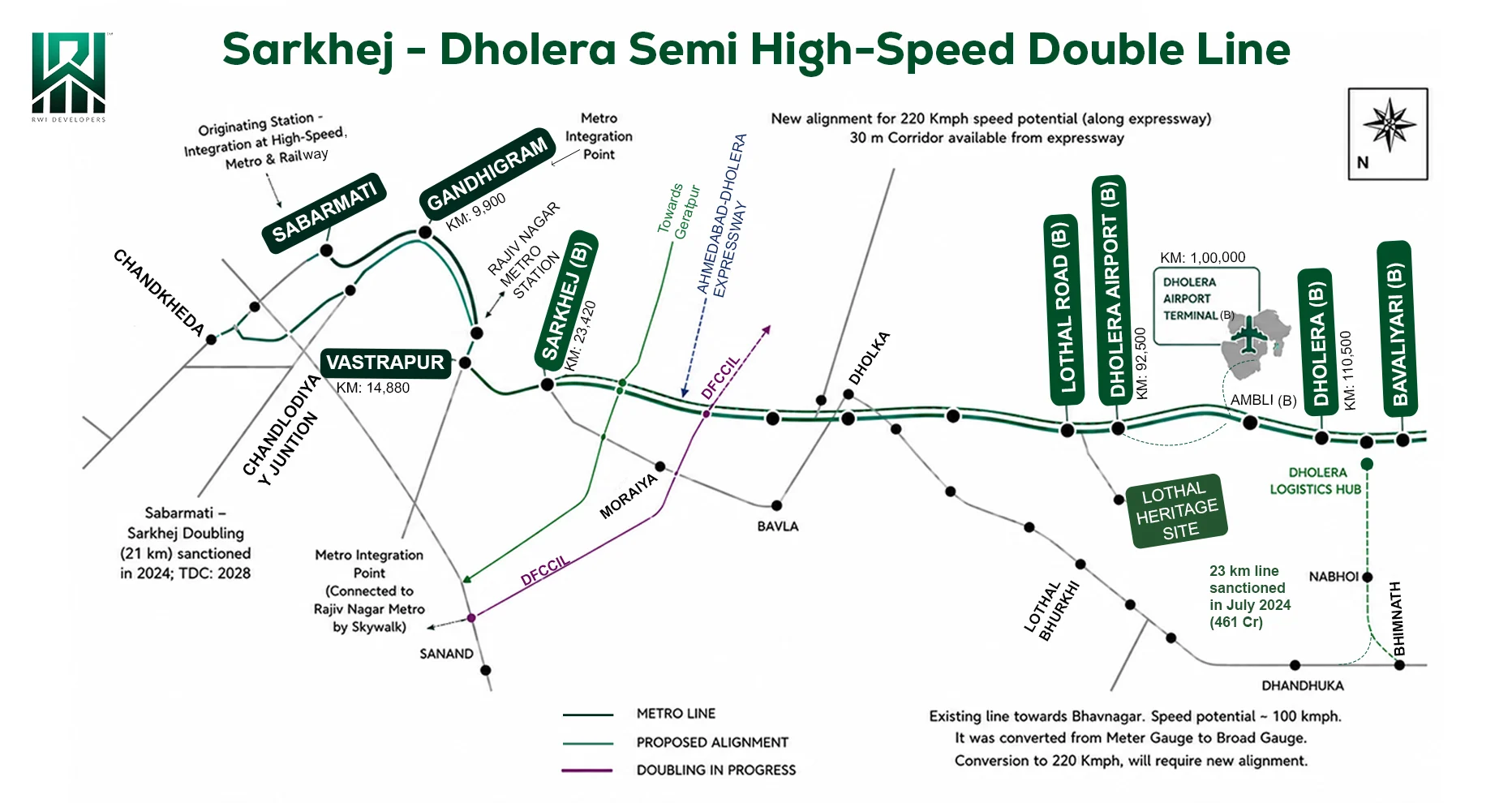
Project: Ahmedabad (Sarkhej)–Dholera Semi High-Speed Rail Corridor
Status: Approved by the Union Cabinet
Project Cost: ₹20,667 crore
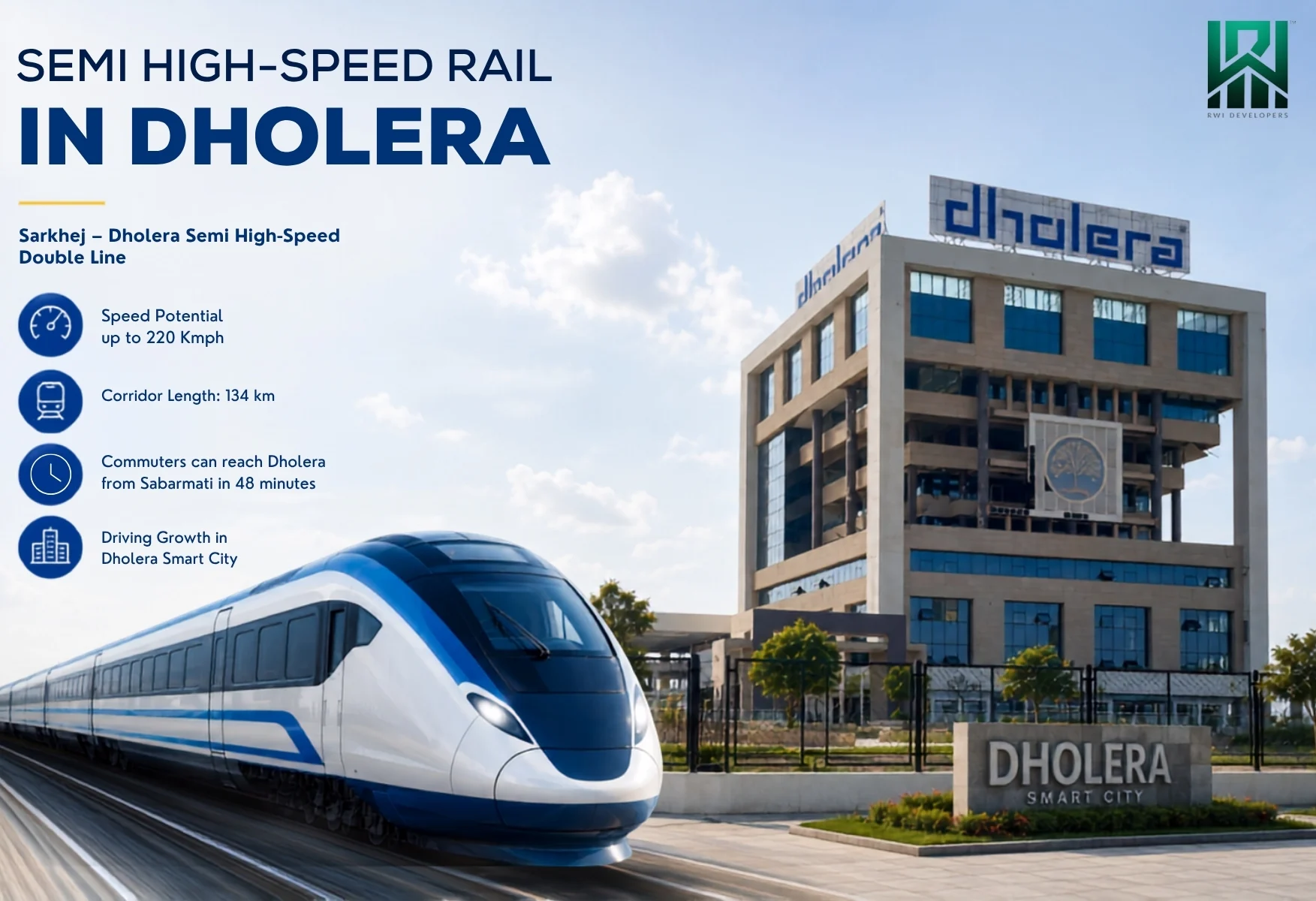
Corridor Length: 134 km
Design Speed: Up to 220 km/h
Expected Travel Time: Around 48 minutes between Sabarmati and Dholera
Purpose: To strengthen regional connectivity while supporting the long-term development of the Dholera Special Investment Region (DSIR).
Why Was Dholera Chosen?
Major infrastructure projects are rarely planned in isolation. They are directed towards regions expected to become important economic and industrial centres in the years ahead.
Dholera already sits at the centre of several nationally significant initiatives, including:
- Dholera Smart City within the Dholera Special Investment Region (DSIR)
- Delhi–Mumbai Industrial Corridor (DMIC)
- Dholera International Airport
- Ahmedabad–Dholera Expressway
- Expanding industrial and logistics infrastructure
Viewed individually, each project strengthens the region.
Viewed together, they reveal a coordinated vision to create an integrated ecosystem for manufacturing, logistics, mobility, and urban development.
The semi high-speed rail corridor is the latest addition to this ecosystem—not the beginning of it.
What Is Happening on the Ground?
One reason this announcement carries significance is because Dholera is no longer just a vision on paper.
Infrastructure development is actively progressing across the region.
The Ahmedabad–Dholera Expressway is improving road connectivity, the Dholera International Airport is advancing towards operations, utility infrastructure is being developed within the activation area, and Tata Electronics’ semiconductor fabrication facility is under construction in DSIR.
Together, these projects are creating the physical foundation required to support industries, skilled employment, businesses, and future residential communities.
Against this backdrop, the semi high-speed rail corridor becomes another strategic layer in Dholera’s growing infrastructure network rather than a standalone announcement.
Why the Rail Corridor Matters
Transportation infrastructure does much more than reduce travel time.
It improves how people move, how industries operate, and how regions connect.
The Ahmedabad–Dholera Semi High-Speed Rail Corridor is expected to:
- Improve regional mobility
- Strengthen connectivity between Ahmedabad and Dholera
- Support industrial and commercial activity
- Improve workforce accessibility
- Complement the airport, expressway, and industrial corridors
Together with these existing infrastructure projects, the rail corridor contributes to a multi-modal connectivity network designed to support long-term regional growth.
More Than a Railway Line
The significance of the project lies not only in speed, but in what the government’s decision represents.
First-of-their-kind infrastructure projects are generally introduced where policymakers see long-term economic potential.
Selecting Dholera for India’s first indigenous semi high-speed rail corridor reflects confidence in the region’s future role as an industrial, logistics, and urban growth centre.
The project also aligns with broader national initiatives such as PM Gati Shakti and the Delhi–Mumbai Industrial Corridor, both of which aim to integrate transportation networks, industrial hubs, and economic regions.
RWI Developers’ Perspective
At RWI Developers, we believe infrastructure should never be viewed as isolated milestones.
Its real value lies in how individual projects come together to shape the future of a region.
The semi high-speed rail corridor complements an ecosystem already being built through industrial investment, airport connectivity, expressway infrastructure, and planned urban development.
This understanding influences how we approach our developments, including Harmony Nest and EstateOne10. Rather than following short-term market sentiment, our focus remains on aligning with the long-term infrastructure vision steadily transforming Dholera.
Final Thoughts
The Ahmedabad–Dholera Semi High-Speed Rail Corridor is more than a transportation project.
It is another indication of the confidence being placed in Dholera as one of India’s emerging infrastructure and industrial regions.
As connectivity, manufacturing, logistics, and urban infrastructure continue to evolve together, Dholera is steadily moving from long-term vision to on-ground reality.
At RWI Developers, we believe understanding these structural developments enables investors and homebuyers to make informed decisions based on long-term fundamentals rather than short-term headlines.